Friday, May 1, 2015

První Máj

Traditional Maypole
Although many people in the Czech Republic celebrate their romantic love on St. Valentine’s Day, there is another day that is much older and much more traditionally Czech: the first of May. 

While the calendar may say that May 1st is Labor Day, the people recognize a different tradition: a celebration of the blossoming of love, coinciding with spring’s arrival. This tradition is much older than the bank holiday of Labor Day, and based on a 19th century Czech love poem by Karel Hynek Macha.

Creative way to celebrate První Máj!   
On the night before the first of May, maypoles are cut down in the forest and prepared by the men of the village. On the first of May, the maypoles are erected and decorated by the townspeople. On this day, the men kiss their sweethearts under a blossoming cherry tree to preserve the lady’s beauty for another year. At night, a group of people sneak into neighboring villages to try and steal each other’s maypoles, and whoever successfully defends their maypole wins. This means that the single men from the village can go around visiting the young single girls and giving them presents.

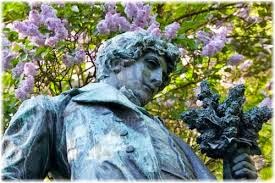
If you live in Prague, there is an additional tradition: In Petřín Park behind the Prague castle, there is a statue of Mácha. If you kiss your lover under the statue’s gaze, it guarantees that your love will be as strong as the stone from which the statue is made.
Statue of Macha

At night on the first of May, the youth from the town put on a May Day Ball, electing a king of the celebration, and showcasing musical and dancing abilities of the town’s youth. Nowadays, these balls have a feeling of a music festival with student parades, costumes, and various performances.

This article was written by Anne H., LAMP Spanish interpreter. 

Tuesday, April 14, 2015

Nepali New Year 2072 B.S.


Happy Nepali New Year 2072 B. S.

Flag of Nepal
     "Nepali" refers to language and the general culture being practiced by people of Nepal and other nationals whose origins are in Nepal. Nepali language has root to the ancient and religious language of India known as Sanskrit.  Therefore, Sanskrit, Hindi, Nepali and many other languages of India use the common script known as Devanagari, one of the few ancient scripts.
     Nepal, a Himalayan country north of India and south of Tibet (China), has its own official calendar known as Vikram Sambat abbreviated as V. S. or B. S. The calendar started in 57 BC and hence, it is 57 years ahead of the Gregorian Solar calendar. The New Year of the Vikram Sambat or Nepali calendar starts between mid- March to mid –April. The New Year starts today, April 14th 2015. The calendar year from today in Nepal is 2072 BS, which is mandatory for both official and religious purposes. However, in India the Hindus follow this calendar for religious significance only; their official calendar is the Gregorian Western calendar.
     Vikramaditya, the Emperor of northwest India, defeated his enemies, the Sakas, in 56BC. As an honor and memory to his great victory, he introduced the calendar: Vikram Sambat. Since then the Indian kings started to use the calendar in the north and the east. From the Indians, the Rana rulers of Nepal adopted the calendar after 1850 AD when military general, Jung Bahadur Rana, defeated King Surendra Shah of Nepal through a military coup and established the Rana regime that ruled Nepal until 1951 AD.
     As in other countries and cultures, Nepali celebrate their New Year with prayers, rituals, family gatherings, socialized gambling, picnic and travelling. Hindu priests offer prayers. Depending on family practices, male goats, buffaloes, sheep, pig and roosters are sacrificed to appease family deities for having helped to fulfill family wishes in the bygone year and then to renew divine protection, favor and successes in the New Year. Similarly, the Hindu astrologers identify the unfavorable influence of planets and stars on the life of each family members in the New Year and then the priests offer prayers and rituals to appease the planets and stars. The Hindus believe that such appeasing to heavenly bodies helps to neutralize malefic effects of the heavenly bodies on the health, career and day-to-day events of each family member. Also, the first month of New Year is the most favorable month for wedding.
     As to the Hindus, the Buddhists too have significance of the first month. Lord Gautama Buddha achieved Buddhahood or enlightenment in the month of Baisakh, the first month of Nepali calendar. Buddhists offer prayers, organize religious dances and celebrations in monasteries, forts and pilgrim sites. During the full moon of the month, Buddhists pilgrims from worldwide visit Lumbini, the birthplace of Lord Buddha in south Nepal.
    
Map of Nepal
Just a week ago, the Hindus celebrated the birthday of Lord Rama along with celebrating His victory over the powerful demon King Ravana of ancient Ceylon. During these festivals, parents and brothers invite their sisters and families to celebrate together by giving gifts and money as a gesture of respect and honor to daughters and sisters. Likewise, businessmen and companies settle their business deals and renew new contracts on these auspicious occasions.
     New Year is an auspicious occasion for festival, ritual, celebrations and family gatherings in Nepal. Both Hindus and Buddhists celebrate the New Year for the entire month. It is also the end of harvest and beginning of new farming season for the Nepalese whose 75 percent population rely on sustainable farming. As a cool and dry season, this time of the year is favorable for all kinds of tourists to visit Nepal and experience intact nature especially in the mid hills and the higher Himalayas popular for rafting, trekking, mountaineering, and experiencing social and cultural diversities of over 104 different ethnic groups in the country with just the size of Iowa (56,000 sq. miles).
                                        
Wish you all Happy New Year 2072.


This article was written by Yadu N., LAMP Nepali interpreter.

Thursday, February 19, 2015

Happy Chinese New Year


Red paper posted on main entrance

      On February 19, more than a quarter of the world's population will celebrate the Chinese New Year. The New Year's Day celebration is on a different date each year because it is based on the lunar calendar that has been followed in China since ancient times. Chinese use the Zodiac to represent a cycle of twelve years. This year, it is the Year of the Sheep.

       Why do we celebrate the New Year? Each culture has its own legend for the reason. The one that belongs to Chinese is spookily interesting.

       It was said that the Year had been a monstrous beast. It had appeared on every New Year's Eve to create havoc, eating people and wrecking houses, at which time everyone locked up windows and doors and hid breathlessly at home. Later on, people realized that the Year was fearful of noises and any color in red, so that on one New Year's Eve when the Year showed up as usual, people began to fire firecrackers and pounded the chop knife against the chop board to make deafening noises in every household. Meanwhile, they were all dressed in shiny red and gave each other money contained in red bags for good luck, while they pasted on top and both sides of the main entrance of buildings poems of auspices written on pieces of brightly red paper. Needless to say, the Year scurried off and never returned. At dawn of the New Year's Day, people emerged safely to cheerfully congratulate each other by saying "good luck for the coming year".


     Traditionally, on New Year's Eve, all family members gather around a table, some grinding pork and some kneading dough, to make dumplings. The dumplings, pretty much round in shape, symbolize fullness. The firecrackers start to blast exactly at midnight of the New Year's Eve nonstop till the New Year's Day. Everyone puts on new clothes and new shoes and says good wishes to every family member. The older generations hand out money in red bags to the younger, much like opening Christmas gifts on the Christmas Day. The grownups who have earned money are to present money in red bags to their parents to show their appreciation. Later that day, friends visit each others homes to wish each other good things to happen in the coming year.

Paper cuttings of lambs
       The New Year's Eve and the New Year's Day are the most important days of the year to Chinese. They represent a time for reunion and new outlook. In Asia, the Chinese New Year is celebrated concurrently in China, Indonesia, Japan, Korea, Malaysia, Taiwan, and Vietnam. The Chinese celebration usually lasts for half a month until the Lantern Festival held in the evening of lunar January 15.


             Even though my husband and I have lived in the States for thirty years, on New Year's Day we have been handing out money in red bags to our two sons, who are very pleased (who wouldn’t be?) to have been able to receive gifts on both the Christmas and Chinese New Year's Days, which are not far apart. We also celebrate by eating dumplings, oranges (also symbolizing fullness), and special sweets. On top of all these, we have always remembered to call our parents in Taiwan to send greetings and regards.

          The Year of the Sheep symbolizes purity and innocence, auspices and satisfaction, and perspiration and perseverance. Best wishes to every one for a fulfilling new year!
Sumei Chi, LAMP Mandarin interpreter and author


Friday, October 31, 2014

Mexican Day of the Dead


Colorful altar with sugar skulls, food, and flowers
     Day of the Dead is a Mexican holiday observed throughout Mexico. The holiday focuses on gathering of family and friends to pray for and remember family and friends who have died. This celebration takes place on October 31st, November 1st, and November 2nd.  On these days people build altars called "Ofrendas" to honor the deceased. Sugar skulls, favorite foods and beverages of the departed, and visiting graves with these as gifts is a common tradition. They also leave possessions of the deceased at their graves.


Altar with food, pictures, and candles 

         This holiday is very important to the Mexican heritage. Schools and government offices usually have altars omitting religious symbols. October 31st refers to inviting the Angelitos (“Spirits of Dead Children”). November 1st refers as Dia de los Inocentes (“Day of the Innocents”), and November 2nd as Dia de los Muertos (“Day of the Dead"). Throughout these 3 days, people go to the cemeteries to be with the souls of other departed and take Pan de Muerto ("Bread for the Dead”) and Cempasuchitl, also referred as Flor De Muerto (marigold flowers). The families also take toys and candles for the children and Tequila, Mezcal, Pulque, or jars of Atole for Adults. The intent for this is to encourage visits by the souls so the souls will hear the prayers and the comments of the living directed to them.

Sugar skulls and Pan de Puerto
        Celebrations can also be humorous as family members remember funny events and anecdotes of the departed.

        Rituals celebrating the deaths of ancestors have been observed by this civilization for as long as 2,500 to 3000 years. In the Pre-Hispanic era, skulls were commonly kept as trophies and displayed during the rituals to symbolize death and rebirth.  Even though this holiday is particularly celebrated in Mexico, other countries like Brazil and Spain and countries in Europe, Asia, and Africa have started similar themed celebrations.

People gather at graves of the deceased


Article was written by LAMP Interpreter, Janette A.